|
|
|
SPRING 2025
|
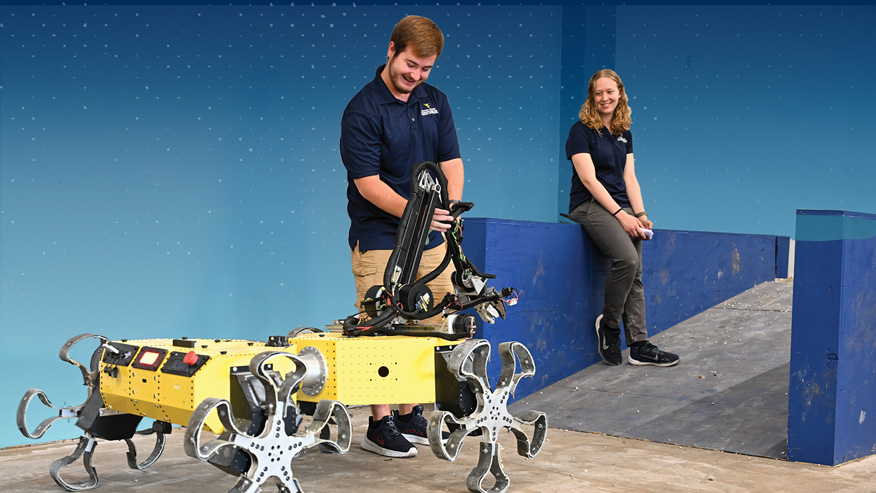 |
Building the Future: How Robotics at West Virginia University is revolutionizing engineering educationIn the heart of West Virginia University, a new chapter in tech innovation is unfolding — one driven by sensors, algorithms and limitless imagination. Discover how Lane Department of Computer Science and Electrical Engineering faculty and researchers in robotics are advancing large-scale applications that aim to improve lives while prioritizing safety and are training students to develop intelligence in robots using machine learning and generative AI.
|

|
 |
Statler College bolsters WVU’s record-breaking NSF research expenditure rankings and breaks some records of its ownWith its unwavering commitment to innovation, electrical engineering was one of three programs in the Statler College that led the College’s HERD rankings with $8.8 million, propelling WVU into the top 100 engineering programs nationwide.
|

|
 |
WVU AI Symposium highlights how promising research, collaborations are shaping the futureThe 2025 WVU AI Symposium brought together thought leaders, researchers and professionals from across West Virginia University to explore how artificial intelligence research is reshaping the way we work, create and solve problems. The organizing committee for the AI Symposium, “AI in Action: Navigating Challenges and Opportunities Across Domains” was led by LCSEE faculty member Prashnna Gyawali.
|
|
|
 |
Innovative research from students take center stage during WVU Research WeekThe Statler College Research Week was filled with brilliant engineering and computer science student research presentations. This year’s winning research group lead by LCSEE graduate student Sephr Karimi demonstrated the “Real Time Modeling and Control Algorithm of a Grid-Connected Battery Energy Storage System.”
|

|
 |
LCSEE student honored with 2025 Order of AugustaLuke Hawranick, a member of the Honors College with 4.0 GPA, will graduate with degrees in mathematics and computer science with an emphasis in cybersecurity and a minor in statistics, is one of two Statler College students honored with the WVU Order of Augusta.
|
|
|
 |
WVU’s Artificial Intelligence Club earns fifth place nationally in NASA’s Lunar Autonomy ChallengeAs first-time participants in NASA’s prestigious Lunar Autonomy Challenge, engineering and computer science students proved to be bold competitors in the world of artificial intelligence.
|
|
|
 |
Cloud hosting software project empowers WVU students for hands-on learning, career readinessStudents in Tom Devine’s software engineering class got a crash course in building the plane as they flew it, harnessing their budding coding skills to create functional web applications that utilize real-world data.
|
 |

|
 |
Outstanding educators, advisors, staff, researchers and faculty recognized at WVU’s Statler CollegeOutstanding Educators recognized were Dale Dzielski and Jignesh Solanki. Outstanding Researchers at the senior level were Jeremy Dawson. Tom Devine was named Outstanding Mentor of the Year. Ron Reaser, recognized as a Dean’s Fellow for Academics, and Mohamed Hefeida was named Dean’s Fellow for Engagement and Outreach.
|
|
|
 |
Devine recognized as one of 2025 Foundation Outstanding TeachersThis year, Tom Devine received the WVU Foundation Awards for Outstanding Teaching. Devine is known for creating engaging and meaningful active learning classroom experiences that make cybersecurity accessible and understandable to most students.
|
|
|
 |
Reaser honored as Honors College Faculty FellowsRon Reaser was honored as one of a new cohort of faculty fellows to help students to seek out new knowledge and connections, explore diverse ideas and apply what they learn to real-world problems.
|

|
 |
Hammock received honorary degree during Statler College CommencementJohn Hammock, LCSEE alumnus and Statler College visiting committee member, was awarded an honorary degree during the ceremony and was Spring 2025 Commencement speaker.
|
|
|
 |
Alumni Who Inspire: Mike SnodgrassSnodgrass shared valuable insights about his journey and the impact of his education, from his early years as a student to his current role as lead AI engineer at Google.
|

|
 |
WVU unveils cutting-edge IDEMIA NSS Biometrics Lab for learning, research and innovationThe state-of-the-art IDEMIA National Security Solutions Biometrics Lab, a hub for research, teaching and innovation was unveiled during a ribbon-cutting ceremony on April 25, 2025.
|
|
|
 |
Trilogy Innovations donates cyber lab to WVU Statler CollegeTrilogy Innovations, Inc., systems and software engineering company, will donate funds for the creation of a cybersecurity laboratory, for students success and cybersecurity training.
|
 |
|
Dear friends and colleagues, As we reflect on the May commencement ceremony, there’s a renewed sense of pride and optimism in the Department. Celebrating the hard work and accomplishments of our students is always a highlight, and this semester has been no exception. From recognition events honoring those on the President’s and Dean’s Lists and Order of Augusta to faculty and student award winners, the spring was full of moments that reminded us of the strength and spirit of our community. We also hosted our first-ever AI Symposium in May — an inspiring showcase of the impactful research being led by our talented graduate students and across WVU. This semester, we saw incredible generosity from our industry partners creating two new Labs: IDEMIA Biometrics Lab and Trilogy Cybersecurity Lab. To everyone who contributed on Day of Giving — thank you. Your support helps move us forward. As we move into summer and enjoy the longer days, it’s also a time for reflection and planning. We remain focused on growing our impact in key areas like digital health, energy systems, AI, cybersecurity, robotics and biometrics. These are not just research themes — they’re where we believe we can make a real difference in the world. This newsletter offers just a glimpse into the energy and excellence within our department. I hope you’ll take a few moments to read about the people and projects shaping our future. Anurag Srivastava
Raymond J. Lane Chairperson of the Lane Department of Computer Science and Electrical Engineering Benjamin M. Statler College of Engineering and Mineral Resources West Virginia University anurag.srivastava@mail.wvu.edu | lcsee.statler.wvu.edu |

|
|
ABOUT THIS EMAIL
Lane Signals is an e-newsletter produced by the Benjamin M. Statler College of Engineering and Mineral Resources' Office of Marketing and Communications. Please share your comments and suggestions by emailing us at engineeringwv@mail.wvu.edu. |
|
MAILING ADDRESS:
Benjamin M. Statler College of Engineering and Mineral Resources | West Virginia University 1220 Evansdale Drive | P.O. Box 6109 | Morgantown, WV 26506-6109 PHONE: 304.293.5263 | EMAIL: Statler-LCSEE@mail.wvu.edu Copyright © 2025 Benjamin M. Statler College of Engineering and Mineral Resources all rights reserved Privacy Policy | Unsubscribe |